If you still think you can spot a fake receipt by eye, 2026 has bad news. A single free prompt now produces a photorealistic receipt - real vendor name, believable items, tax that adds up, even a paper-fold shadow. There is nothing left to notice.
The scale caught most finance teams off guard. By mid-2026, AI-generated receipts made up roughly 71% of flagged expense fraud - up from essentially zero a year earlier. One major expense platform now tells customers plainly: don't trust your eyes.
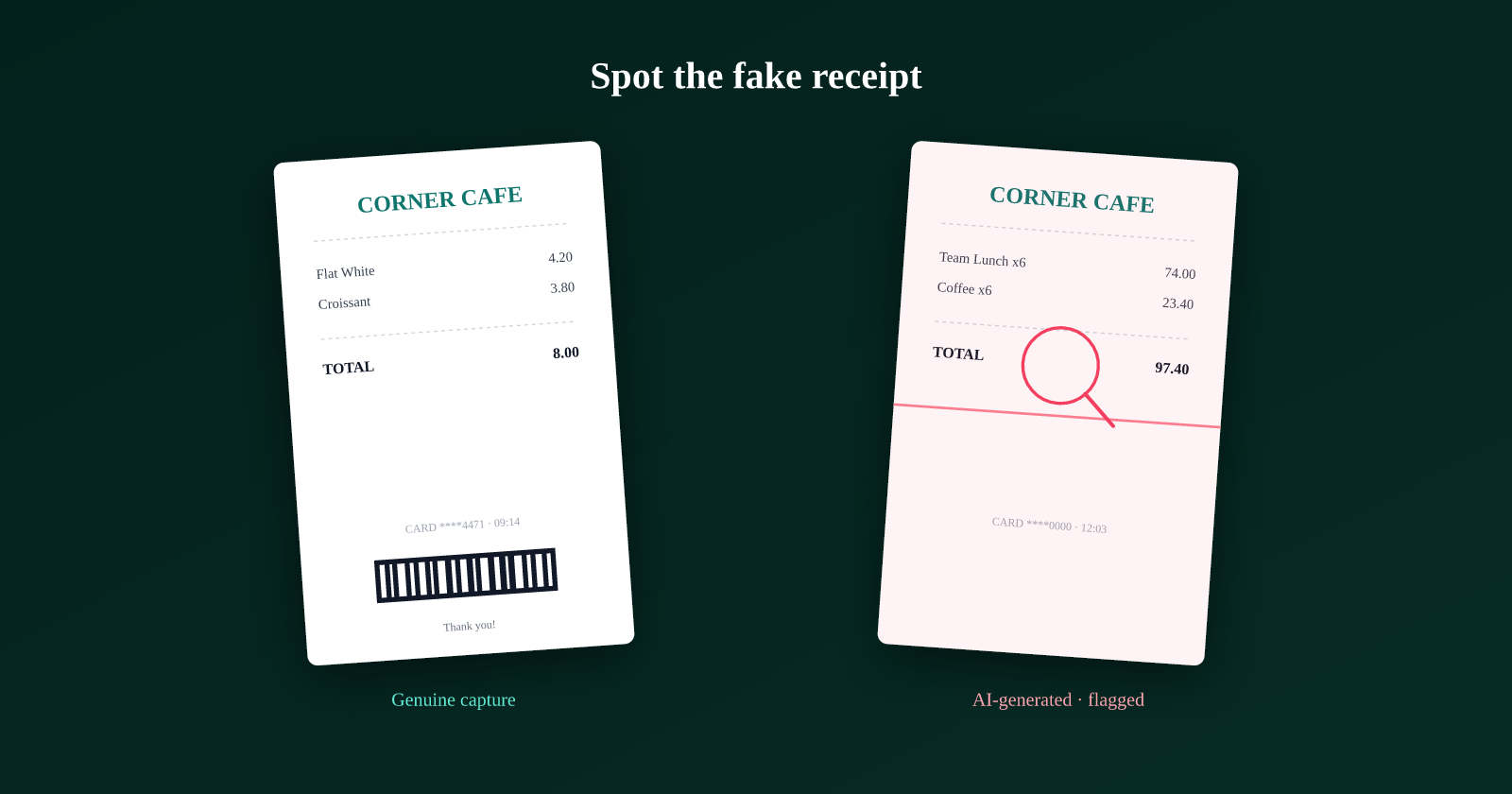
Why you can't eyeball a fake receipt anymore
For years, fabricated receipts gave themselves away. A logo stretched slightly wrong. A font that didn't match the store. A total that didn't add up to the line items. Reviewers learned the tells, and most fakes got caught on sight.
AI erased all of that. Today's generated receipts have correct branding, realistic prices, tax lines that reconcile, and image "noise" that mimics a phone photo. There is no visual mistake to catch - because the whole point is that there isn't one.
The dangerous part isn't the one big fake. It's the small ones. AI receipts cluster just under common auto-approval thresholds - a $98 dinner, a $45 taxi - so they clear without a human ever looking. The loss is slow, steady, and easy to miss.
How to tell if a receipt is fake: 5 signs that still hold up
You can't rely on how a receipt looks. But the story around it still leaves gaps. Here's what a careful reviewer - or an automated check - can still catch.
1. There's no matching payment trail
A real purchase leaves a second record: a card transaction, a bank line, a vendor confirmation email. An AI receipt exists only as an image. If a claim can't be matched to any independent trace of the money actually moving, that's the strongest signal there is.
2. The amount is suspiciously convenient
Fabricated receipts tend to land at oddly round numbers, or precisely one or two dollars below an approval limit. A cluster of claims that all sit at $99 when the auto-approve cutoff is $100 is not a coincidence.
3. The same receipt keeps coming back
One of the oldest tricks, now easier than ever: the same template reused across many claims, or one receipt resubmitted with the date nudged. A line-by-line reviewer rarely connects two claims filed weeks apart - but the repetition is obvious once you look for it.
4. The capture history doesn't fit
A genuine phone photo of a receipt carries a trail: camera details, a natural imaging history, the marks of a real lens. Generated images arrive stripped of that, or with details that contradict the story - a "photo taken on a phone" that was never near a camera.
5. The vendor details don't quite line up
AI receipts are often assembled from mismatched parts. A store address in one city, an area code from another. A currency symbol that doesn't match the claimed location. A date format the real vendor never uses. Individually small; together, a pattern.
Notice what's missing from this list: "the font looks off" and "the math is wrong." Those tells are dead. The signs that survive are about provenance and consistency - whether the receipt was ever real, not whether it looks real.
Why manual review can't keep up
Even a sharp reviewer can apply these checks to a handful of receipts. The problem is volume. Expense fraud works precisely because no one has time to trace the payment trail behind every $40 lunch, and the fakes are priced so that no one has to.
That's the gap. The controls most teams rely on - a manager's glance, an approval threshold, a monthly reconciliation - were built for a world where fakes were rare and obvious. AI made them common and invisible at the same time.
What finance teams can actually do
The fix isn't to look harder. It's to check earlier and automatically.
- Verify at submission, not at reconciliation. A receipt flagged in the moment routes to review before the money leaves. A receipt caught at month-end is already gone.
- Run a forensic check, not just OCR. Reading what a receipt says - vendor, date, total - assumes the pixels are genuine. The separate, more important question is whether the image was authentically captured or generated. That's exactly the question AI receipts exploit, and it's covered in more depth in document tampering detection vs OCR.
- Look for reuse across claims, not just within one. Duplicate and near-duplicate detection catches patterns a single reviewer never sees.
- Don't treat receipts in isolation. The same forensic logic applies to tampered bank statements and fake payslips - and increasingly to the invoices behind insurance claims. Fraud rings reuse templates across all of them.
Check a receipt in about a minute
Upload a receipt - real or AI-generated - and get a forensic verdict on whether it was genuinely captured. $5 in free credits, no contract.
Test a fake receipt →Automated receipt fraud detection runs these checks on every receipt at submission - AI-generation signatures, capture provenance, arithmetic, duplicates, and vendor consistency - and returns a plain-English verdict, so your team reviews the handful that matter instead of guessing on all of them.
FAQ
- How can you tell if a receipt is fake?
You usually can't tell by looking - modern AI receipts have correct branding, realistic prices, and totals that add up. The reliable signs are about provenance and consistency: no matching card or bank record, amounts suspiciously close to approval limits, the same receipt reused across claims, missing camera/capture history, and vendor details that don't line up.
- Can you make a fake receipt with AI?
Yes, and that's the core of the problem. Free tools generate photorealistic receipts from a short prompt, complete with vendor logos, believable line items, and reconciling tax. By 2026 these accounted for the majority of flagged expense fraud. The fakes are designed to pass a visual glance, which is why detection has moved to forensic and provenance checks.
- Are AI-generated receipts detectable?
Not by eye, but yes forensically. Generated images carry the rendering and noise signatures of an image generator rather than a real camera or point-of-sale printer, and they lack genuine capture metadata. Automated detection also cross-checks arithmetic, duplicates, and vendor consistency - signals that hold up even when the receipt looks flawless.
- How do companies verify expense receipts at scale?
Manual review doesn't scale, so companies increasingly run an automated forensic check on every receipt at the point of submission - via an API or dashboard - that returns a verdict in about a minute. Suspicious receipts route to a human before reimbursement; the rest clear automatically. This catches AI-generated and duplicate receipts that threshold rules and eyeballing miss.
- What's the difference between OCR and receipt fraud detection?
OCR reads the text on a receipt and assumes the pixels are real - it has no opinion on whether the receipt was ever captured. Fraud detection asks the separate question of authenticity: was this image genuinely photographed, or generated and edited? AI-generated receipts exploit exactly that gap, which is why OCR-based expense tools alone don't catch them.