Blog
Insights on document fraud
Forensic analysis, developer guides, and fraud patterns - from the team building TamperCheck.ai's platform for automated document fraud detection.
How to Verify a Contract in 2026: 8 Checks for Tampering and AI Fakes
A contract that says "signed" is not the same as a contract that is genuine. Here are the 8 checks - from e-signature validation to scanned-copy forensics to AI-fabrication tells - that tell you whether the agreement in front of you is the one that was actually agreed.
Read article
What to Check Inside a Bank Statement: A Field-by-Field Verification Checklist
Most guides tell you which forensic techniques exist. This one walks the document itself - header, account block, summary box, ledger, page breaks, stamps - and tells you exactly what to check in each region, what fraud lands there, and where the check stops working.
Document Tampering Detection Software: How to Choose One in 2026
Most teams evaluate document tampering detection software by uploading one obvious fake and seeing if it gets flagged. That test tells you almost nothing. Here are the nine criteria that actually separate production-grade detection from a demo.
Document Fraud Went Field-Level. Most Detection Still Scores the Whole Page.
Entrust, Sumsub, Inscribe, and Resistant AI all published the same story this year: AI fraud is up, deepfakes are up, everyone's scared. True, and beside the point. The real shift is that forgery moved from the page to the field - and most detection stacks are still scoring the page.
We Invented a Student, a School, and a Report Card. Here's Why It's Fake.
No student, no school, no exam ever produced this mark sheet - we generated it ourselves to test our own detector. It's clean, consistent, and unremarkable to look at. That's exactly why it's a useful example of what an AI fake document detection check needs to catch.
One Number on This Degree Certificate Is Fake. Can You Spot It?
Everything on this degree certificate is genuine except one number - the CGPA was pasted in after the fact. It's a small, deliberate edit, and it's a completely different kind of fake to catch than a document invented from scratch.
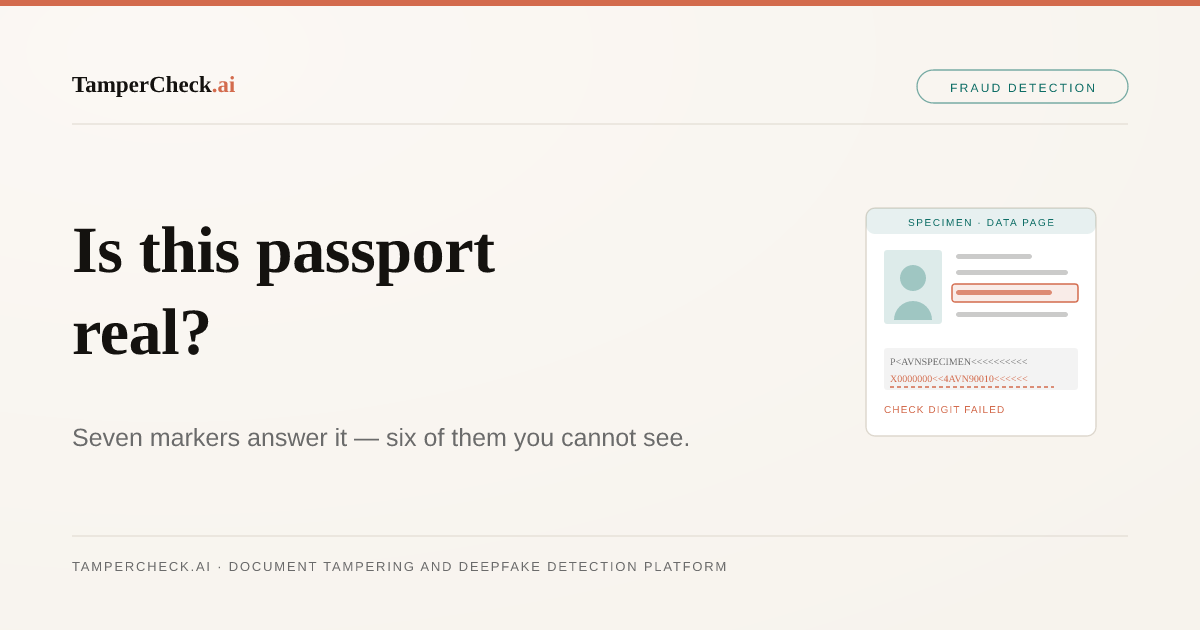
Is This Passport Real? Walking Through the AI Markers in a Tampered ID
Someone sends you an ID and asks: is this document real? You can't answer that by looking. Here are the seven markers an automated fake document checker actually finds in a tampered passport - and why six of them are invisible to the eye.
Document Fraud in 2026: The Numbers Every Onboarding Team Should Know
A mid-year, source-linked roundup of the document and identity fraud numbers shaping 2026 - the deepfake surge, what it's costing, and what the data says about detection. Bookmark it.
The EU AI Act Just Made Your Fraud Checks 'High-Risk' - What It Means for Document Verification
On 2 August 2026, the EU AI Act's obligations for high-risk AI systems took effect - and identity verification, credit scoring, and insurance are named categories. If document checks feed those decisions, the bar for transparency and auditability just moved.
A $2M Book Deal, an AI Detector, and the Real Way to Prove Something Is Authentic
A debut novelist's $2M deal was withdrawn after an AI detector flagged the manuscript - a case he disputes. Set aside who's right: it exposes a bigger problem. A single AI-probability score isn't proof. Here's what actually proving authenticity looks like in 2026.
How to Spot an AI-Generated Fake Receipt (Most People Can't)
The old tells for a fake receipt - blurry logos, wonky fonts, totals that don't add up - are gone. AI now makes receipts that look perfect. Here's how to tell if a receipt is fake and what finance teams can actually do about it.
What Is a Deepfake? (And Why Deepfake Documents Are the Fraud You Haven't Prepared For)
Most people picture a fake video when they hear 'deepfake.' The version that's quietly costing lenders, insurers, and universities real money is a fake document - and it's a different problem with a different fix.
Think you can spot a fake?
Upload a real document or a fake one and get a forensic verdict in about a minute. We match your first top-up in credits.