Credential fraud is older than the internet, but the internet made it radically easier. Diploma mills sell authentic-looking degrees for a few hundred dollars. Skilled fraudsters alter genuine certificates from real universities. Generative AI produces convincing academic documents from scratch. And most HR screening processes (a visual check of a PDF attachment) have no hope of catching any of these.
The downstream cost of a single missed credential fraud can be enormous: regulatory liability (for licensed professions), negligent hiring claims, patient or client harm in healthcare and legal contexts, and the operational cost of employing an unqualified person in a critical role.
AI document fraud detection addresses the document layer of this problem: verifying that the credential itself is genuine before any background check begins.
Types of Credential Fraud
Diploma mill certificates: purchased degrees from non-accredited institutions designed to look legitimate. The institution exists only to sell credentials, with no actual educational program.
Altered genuine certificates: a real certificate from a real institution, modified to change the name, date, grade, or qualification. The institution is genuine - the holder's details are not.
Fabricated certificates: documents created from scratch to resemble a real institution's degree format. Templates are widely available; the font, seal, and layout are copied from publicly available genuine examples.
AI-generated credentials: synthetically created documents with no physical original. These are the newest category and are increasingly indistinguishable from altered genuine documents.
Third-party document use: a certificate submitted by someone other than the stated graduate - either with the original holder's details intact (hoping the hiring manager won't notice) or with the name changed.
Forensic Signal 1: Institution Verification
The first check is whether the awarding institution exists and is accredited:
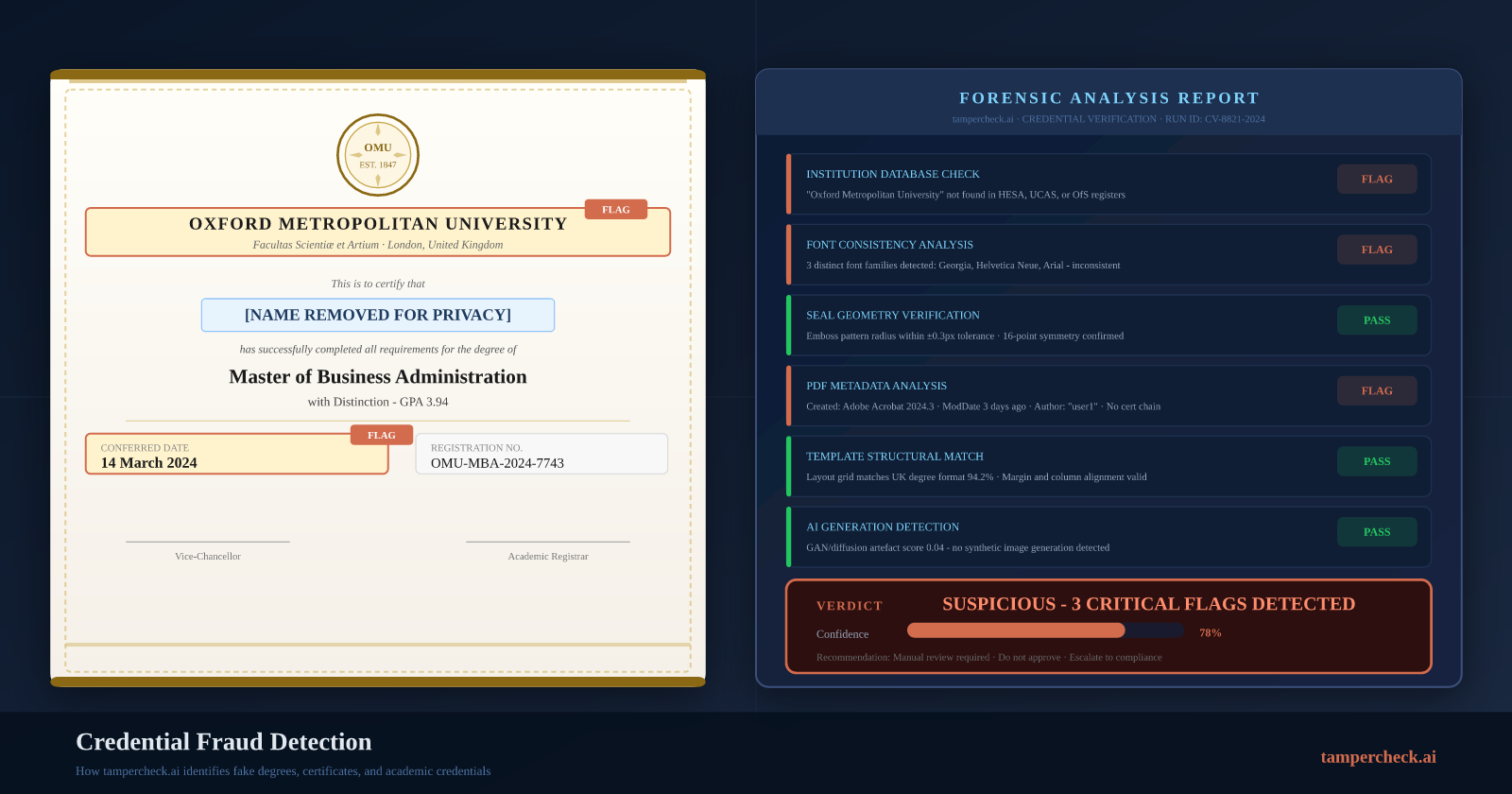
- Accreditation database lookup: AI agents cross-reference institution names against accreditation authority databases (TEQSA in Australia, QAA in the UK, CHEA in the USA). Non-accredited institutions are flagged.
- Institution name fuzzing: diploma mills often use names similar to legitimate institutions ("University of London" vs. "University of London Worldwide Studies"). Near-match detection flags suspicious names.
- ABN/charity registration: legitimate universities are registered charitable entities with verifiable registration numbers that should be consistent with the stated institution.
Forensic Signal 2: Document Template and Layout Analysis
Each university's certificates follow a specific template: precise logo placement, specific fonts, standard seal positioning, and consistent credential language. AI agents verify:
- Logo integrity: university logos are high-resolution vector graphics in genuine certificates. Rasterised or blurry logos indicate reproduction from a screen capture or low-quality copy.
- Seal analysis: university seals have specific geometric structures, Latin text, and heraldic elements. Compressed, distorted, or simplified seals are indicators of fabrication.
- Font identification: universities use specific fonts on their official documents. An altered or fabricated certificate using the wrong font family - even if visually similar - is detectable.
- Field position consistency: the name, qualification, and date fields should appear at exact positions consistent with the certificate series.
The most convincing fake credentials are altered genuine certificates, because they carry authentic logos, seals, and fonts - only the holder's name or qualification has changed. Font metrics and ELA are the primary tools for catching these.
Forensic Signal 3: Pixel-Level Analysis
For certificates submitted as scanned images or photographs:
- ELA (Error Level Analysis): edited regions (where a name, date, or grade has been replaced) show distinct compression artefacts at their boundaries.
- Clone detection: copy-pasted regions from other parts of the document (or from another document entirely) leave statistical fingerprints in pixel distributions.
- Signature zone analysis: an official signature on an academic document should have natural pen-stroke characteristics. A pasted, reprinted, or digitally placed signature has different boundary and noise properties.
Forensic Signal 4: Date and Name Arithmetic
Graduate certificates carry multiple date references and the graduate's full name as recorded by the institution. AI agents check:
- Date plausibility: a Bachelor's degree cannot precede a listed enrollment date; a PhD cannot precede the Bachelor's degree. Dates must be internally consistent.
- Name format consistency: the full legal name on the certificate should be consistent with naming conventions for the stated nationality and institution.
- Graduation date vs degree program duration: a 4-year engineering degree with an issue date 2 years after enrollment is implausible.
Forensic Signal 5: AI Generation Detection
Synthetically generated credential documents have statistical properties distinct from scanned or photographed genuine certificates:
- Pixel noise profiles: genuine certificates photographed or scanned have specific sensor noise characteristics. AI-generated documents have smooth textures with different high-frequency properties.
- Background texture analysis: aged paper, security patterns, and watermarks in genuine certificates have physical properties that generative AI reproduces imperfectly.
- Over-formality and implausible specificity: LLM-generated text in credentials sometimes includes unusually formal phrasing or specific details (e.g. a precise GPA in a format that institution doesn't use).
What AI Verification Doesn't Replace
AI document forensics verifies that the document is genuine - not that the claimed qualification was actually awarded to this person. Two additional steps complete credential verification:
- Primary source verification: contacting the institution's registrar directly to confirm the award (manual, but definitive).
- Identity matching: confirming that the person submitting the certificate is the person named on it (via identity document matching and liveness).
AI document verification is the first filter that eliminates the majority of fraudulent submissions before these more expensive steps are needed.
Running AI document verification first reduces the volume of primary source verifications needed by eliminating obviously fabricated documents. The expensive manual steps focus only on documents that passed the forensic check.
Implementation for HR Teams
The integration is straightforward: at the point where a candidate uploads credential documents during onboarding or pre-employment screening, the documents are submitted to the AI document verification API. Verified documents proceed; suspicious documents are held for additional review or primary source verification.
This adds a minute to the upload workflow and zero additional burden on the candidate, while systematically closing the document fraud gap that manual HR review misses.
Verify credential documents within seconds
Upload any degree, diploma, or professional certificate and get a forensic verdict in a minute. Free to start.
Test a fake document →FAQ
- Can AI verify professional licences as well as academic degrees?
Yes. Professional licences (medical, legal, engineering, financial services) follow similar forensic patterns - institution/authority verification, template analysis, font metrics, ELA. Specific checks are adapted for licence document formats.
- What happens if a genuine certificate fails a forensic check?
A small percentage of genuine documents may trigger low-confidence signals due to unusual printing or scanning quality. These are returned as "suspicious" rather than "likely tampered" and routed to human review rather than auto-rejection. The AI's signal breakdown guides the reviewer.
- Does AI credential verification work for international qualifications?
Yes, with coverage varying by country. Common source countries for international qualifications (UK, USA, Australia, EU, India, China) have strong coverage. Less common source countries may return an "inconclusive" verdict, triggering primary source verification.
- How does credential fraud relate to the wider document fraud problem?
Credential fraud uses the same underlying methods (fabrication, alteration, and misuse) as financial document fraud. The forensic techniques (ELA, font metrics, metadata analysis, template matching) are directly applicable. For the complete taxonomy of document fraud types and detection signals, see the Document Tampering and Fraud Complete Guide. For the KYC application, where identity documents and financial documents are verified in the same workflow, see Automated KYC Document Verification.