Insurance fraud accounts for approximately 10% of all claims costs in mature markets - a figure cited consistently by the Coalition Against Insurance Fraud, the FBI's Financial Crimes Unit, and equivalent bodies in the UK (Insurance Fraud Bureau) and Australia (Insurance Fraud Bureau of Australia). The overwhelming majority of it is document fraud: an inflated repair invoice, a fabricated specialist quote, a medical report with altered diagnosis codes, or a receipt for goods that were never purchased.
Unlike identity fraud, which requires elaborate impersonation, document fraud requires only a PDF editor and the willingness to submit false information. At scale, this becomes systematic: organised rings that inflate auto repair costs across hundreds of claims simultaneously, knowing that individual adjusters won't catch small discrepancies.
AI agents running document fraud detection checks at submission change this calculus entirely.
The Insurance Document Stack
Insurance claims require multiple supporting documents, each with distinct fraud vectors:
Vehicle repair claims: repair invoices, supplementary estimates, photos of damage. Fraud here involves inflating labour hours, adding parts that weren't replaced, or fabricating damage entirely.
Property claims: builder quotes, contractor invoices, receipts for damaged goods. Fabricated quotes from non-existent tradies or inflated replacement values are common.
Medical/disability claims: GP reports, specialist assessments, hospital discharge summaries. Altered diagnosis codes, fabricated severity ratings, and copied-and-modified letters are frequent fraud vectors.
Income protection claims: payslips, employer confirmation letters, accountant's letters. These overlap directly with the payslip fraud patterns.
How AI Forensic Analysis Applies to Claims
Invoice and Quote Integrity
Every legitimate invoice and trade quote shares structural characteristics: sequential invoice numbers, consistent ABN/trading entity details, standard tax calculation (GST/VAT applied correctly), and layout consistent with the claimed business.
AI agents verify:
- GST/VAT arithmetic: the tax figure must equal exactly 10% (Australia), 20% (UK), or the applicable rate of the pre-tax total. A single editing error in a fabricated invoice almost always breaks this.
- ABN/company registration: the ABN on the invoice must be active, registered to the stated business name, and operating in the claimed industry. A "panel beater" with an ABN registered to a restaurant is an immediate signal.
- Sequential invoice numbering: a claimant submitting multiple invoices from the same supplier should show sequential numbering consistent with normal business operations. Claimants fabricating invoices often create multiple documents with non-sequential numbers.
- Line item arithmetic: total must equal the sum of line items. Inserted or altered line items frequently break this.
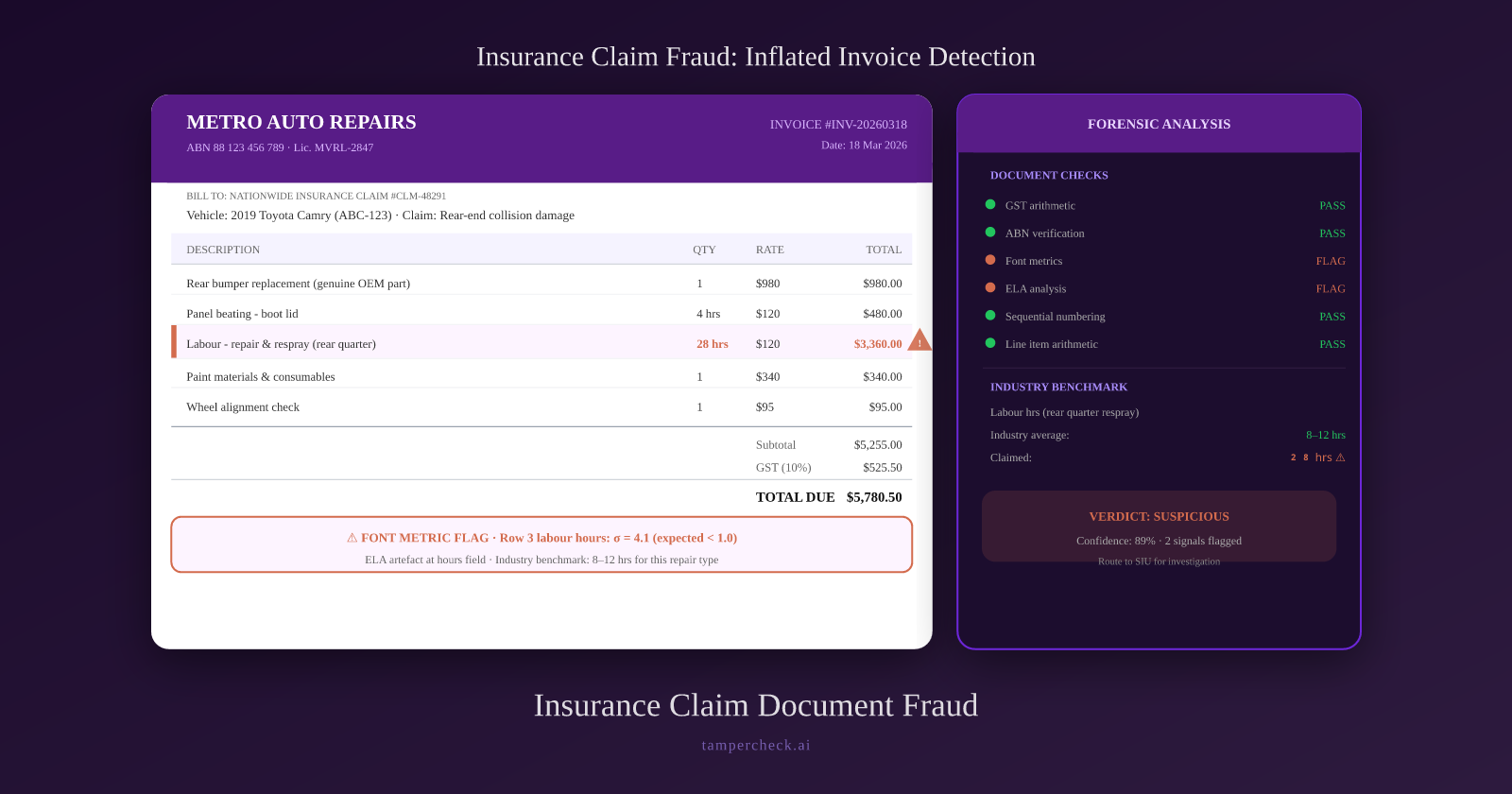
The most common insurance invoice fraud is the "inflated genuine invoice" - a real invoice from a real business, with one or two line items increased. The ABN checks out, the business exists, but the amounts don't match what was actually charged. Font metrics and ELA catch this.
Medical Document Analysis
Medical reports and discharge summaries have specific structural requirements that AI agents verify:
- Letterhead and provider credentials: the medical provider's details (name, registration number, practice address) should be consistent with registered providers in the stated jurisdiction. Fabricated letterheads using non-existent practitioners are immediately flagged.
- Date consistency: treatment dates must be internally consistent - a discharge summary shouldn't predate the admission date; a specialist report shouldn't predate the referral.
- Diagnosis code verification: ICD-10 codes used in medical documents should be valid codes and consistent with the narrative description. A fraudulently altered diagnosis code may conflict with the surrounding clinical narrative.
- Structural template matching: genuine medical reports from large hospital systems follow consistent templates. Documents deviating from the expected template for the claimed institution are flagged.
Photo Evidence Analysis
Motor vehicle and property claims are supported by photos. AI agents analyse submitted images for:
- EXIF metadata: genuine claim photos should have camera metadata consistent with a recently captured image. Missing, inconsistent, or future-dated EXIF metadata is a fraud signal.
- AI generation detection: AI-generated damage photos (synthetically produced to support a fabricated claim) have statistical properties that distinguish them from genuine photographs.
- Image manipulation: pasting additional damage onto a genuine photo, or reusing the same damage photo across multiple claims, is detectable via clone detection and reverse image matching.
- Metadata date consistency: photo dates should be consistent with the claimed incident date.
The Claims Fraud Pattern Library
AI agents are trained on common fraud patterns, enabling direct pattern matching:
Pattern 1 - Padded invoice: Genuine invoice with one or more line items increased. Caught by: font metrics, ELA, GST arithmetic.
Pattern 2 - Phantom invoice: Invoice from a non-existent or unrelated business. Caught by: ABN/company registration lookup, business-category mismatch.
Pattern 3 - Recycled report: A medical or vehicle assessment copied from a previous claim and modified. Caught by: structural template comparison, date arithmetic.
Pattern 4 - Fabricated quote: An estimate produced by an online invoice generator, never from a real business. Caught by: PDF metadata (generator tool signature), ABN check, sequential numbering.
Pattern 5 - Synthetic damage photo: AI-generated or manipulated image submitted as claim evidence. Caught by: AI generation signatures, ELA, EXIF analysis.
Integration into the Claims Workflow
AI document verification plugs into the claims submission workflow at the point of document upload - before the claim reaches an adjuster:
Claimant uploads documents
        ↓
AI forensic check (~1m per document on average)
        ↓
All clear → Route to standard processing
Suspicious → Route to adjuster with AI findings highlighted
Likely tampered → Flag for Special Investigations Unit
The adjuster reviewing a suspicious claim receives the AI's findings pre-loaded: "Font metrics show an outlier in the labour hours field. ELA detected compression artefacts consistent with value substitution. GST arithmetic passes." This transforms a vague "needs review" into a targeted investigation.
Claims verified as clear by the AI agent can be processed faster - reducing turnaround time for genuine claimants while concentrating investigator attention on the 5-15% of claims that show forensic signals.
ROI Calculation
For an insurer processing 10,000 claims per month with an average claim value of $3,000:
- Estimated fraud rate: 10% → 1,000 fraudulent claims per month
- Average fraudulent amount per claim: $800 (inflated, not total fabrication)
- Potential monthly fraud losses: $800,000
- AI detection rate (multi-signal): ~75% of fraudulent claims
- Monthly savings: $600,000
- API cost at 10,000 analyses: minimal compared to savings
The economics of AI document verification strongly favour implementation even at low volumes.
Verify insurance claim documents within seconds
Upload any claim document (invoice, quote, medical report) and get a forensic verdict in a minute. Free to start.
Test a fake document →FAQ
- Can AI verify handwritten medical notes or forms?
Handwritten documents are analysed using OCR to extract text, which is then subject to semantic consistency and date-arithmetic checks. Pixel-level forensics (ELA, font metrics) are less applicable to handwritten documents, but metadata, structural, and content checks still apply.
- Does AI document verification replace fraud investigators?
No. AI verification handles the forensic layer and triage - identifying which documents warrant investigation and providing forensic context. Special Investigations Unit teams make the final fraud determination and handle regulatory reporting.
- How does AI handle claims with multiple documents?
Each document is analysed individually, but the AI also performs cross-document consistency checks: dates must be consistent across documents, the claimed supplier on the invoice must match the business name in correspondence, and total claimed amounts must be consistent across supporting documents.
- Where does insurance fraud fit in the wider document fraud landscape?
Insurance claim fraud is one of the highest-value applications of document forensics. For the full picture, covering financial services, KYC, rental, and HR, see the Complete Guide to Document Tampering and Fraud. For the forensic signal details that apply across all document types, including invoices, see Document Tampering Detection vs OCR.