A fraudulent loan applicant doesn't need to fabricate an entire bank statement. They only need to change three numbers: the opening balance, one or two deposits, and the closing balance. Done carefully in a PDF editor, the result looks authentic to the human eye and passes most manual reviews.
AI agents running bank statement fraud detection catch these alterations in a minute. Here's what they look for.
Why Bank Statement Fraud Is Rampant
Bank statements are the most commonly requested income evidence in lending, tenancy, and KYC workflows, and the most commonly forged. Unlike payslips, which require knowledge of an employer's layout, bank statements follow standard formats that are easy to replicate. Dozens of tools online generate convincing PDFs with custom balances.
Fraudulent bank statements are specifically designed to pass casual visual inspection. Relying on human reviewers alone creates a systematic gap that sophisticated applicants exploit at scale.
The risk isn't just one bad loan. Organised fraud rings submit the same altered template across hundreds of applications simultaneously.
Signal 1: Balance Arithmetic Failure
Every legitimate bank statement satisfies a simple identity:
Opening balance + sum of credits − sum of debits = closing balance
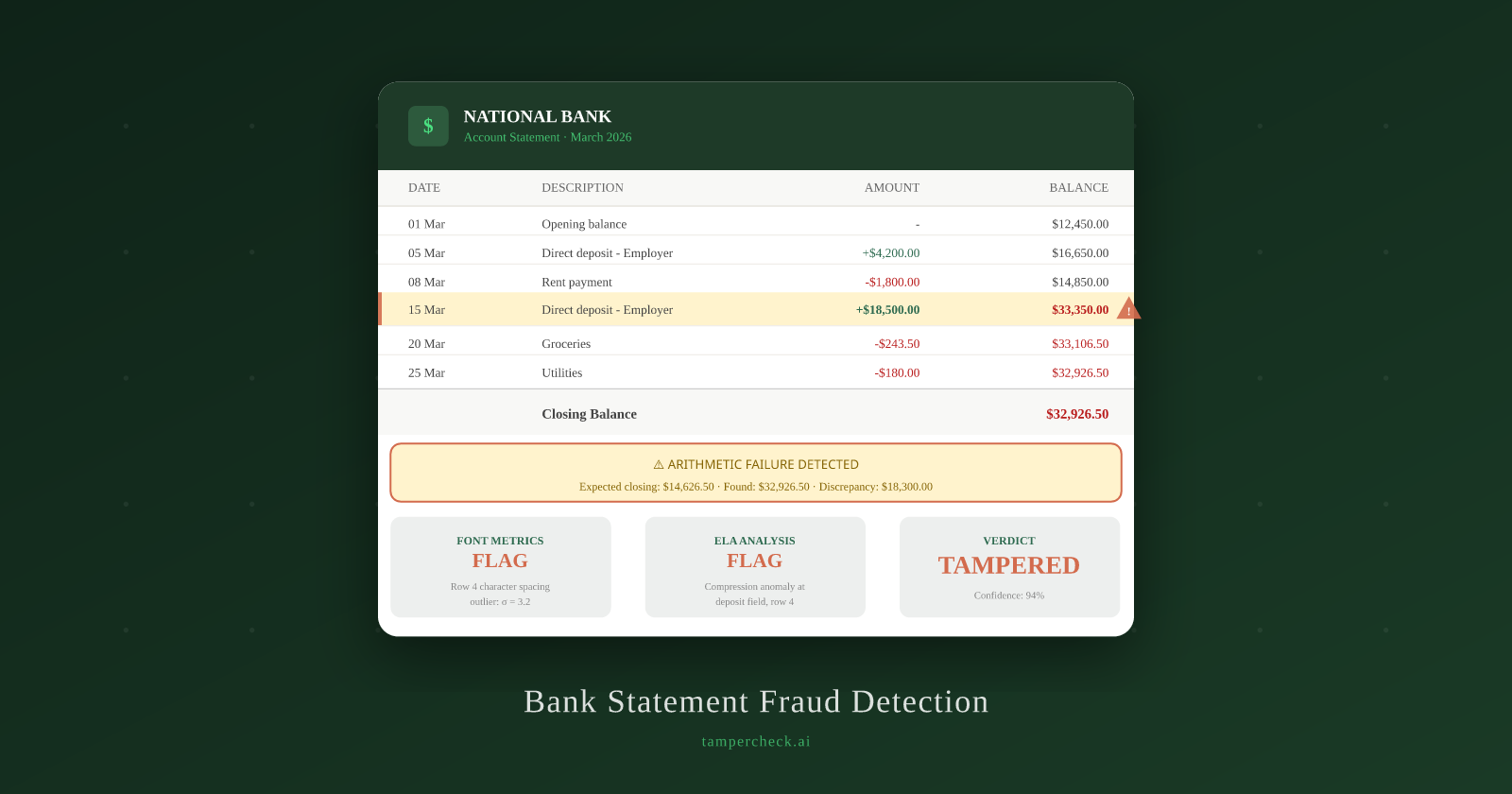
AI agents verify this across every page boundary. A single fraudulent deposit that wasn't properly reflected in the closing balance, or an altered opening balance, breaks the arithmetic. This check catches the most common form of tampering: inflating a deposit without adjusting the running total.
Signal 2: Running Total Inconsistency
Beyond the summary totals, each transaction row carries a running balance. The delta between consecutive rows must exactly match the transaction amount. When a row is inserted, deleted, or modified, the running balance chain breaks, even if the fraudster remembered to update the opening and closing figures.
This is the check that catches "invisible" row insertions: transactions added between existing rows, where the only visible anomaly is a running-balance discontinuity.
Signal 3: Font and Rendering Metrics
Text extracted from a genuine bank statement is rendered in one consistent pass by the institution's PDF generator. When a value is changed in a PDF editor, the replacement text is often rendered with:
- A marginally different font weight or kerning
- A slightly different character spacing
- A different PDF operator sequence that the underlying text layer exposes
AI agents compare character-level rendering metrics across all numeric fields. An edited balance stands out as a statistical outlier even when the font name matches.
Signal 4: Pixel-Level Compression Artefacts
JPEG and PDF compression is applied uniformly across a genuine document. When a region is edited and re-saved, the compression block boundaries no longer align with the surrounding content. Error Level Analysis (ELA) maps these discrepancies visually:
- Unedited regions show a consistent noise floor
- Edited regions show elevated or suppressed error levels that stand out against the background
ELA is particularly sensitive to numeric field replacements, where a small white rectangle is pasted over an original value before the new value is typed in.
Signal 5: Metadata and Creation Tool Mismatch
Every PDF carries metadata: the software that created it, the creation timestamp, and (for modified documents) the modification timestamp and the modifying tool. AI agents cross-reference this against expectations:
- A document claiming to be from Westpac's internet banking but created in Adobe Acrobat Pro is suspicious
- A statement with a 2025 date range but a 2019 PDF creation timestamp indicates the template predates the claimed period
XMP,EXIF, and PDF object metadata are compared for internal consistency
Signal 6: Text Layer vs Visual Layer Discrepancy
Legitimate bank statements generated by banking systems embed a text layer that matches the visual content precisely. When a value is altered in the visual layer (by pasting an image over it), the underlying text layer retains the original value.
AI agents compare the extracted text layer against the visual content using OCR. A discrepancy between what the document "says" in its text layer and what it visually displays is a strong fraud signal.
Signal 7: Structural Layout Anomalies
Banking institutions maintain rigid layout templates across all statements. Column alignment, row spacing, header positioning, and table grid lines follow fixed measurements. When a row is inserted or a value is repositioned, alignment variance analysis detects the deviation:
- Row heights that don't match the standard template
- Transaction text that is offset by fractional points from the column baseline
- Grid lines that don't fully span a modified row
These spatial anomalies are invisible to the human eye at normal reading distance but are statistically significant in automated analysis.
The most sophisticated bank statement frauds fail on multiple signals simultaneously: they fix the arithmetic but miss the font metrics, or correct the metadata but leave ELA artefacts. Multi-signal analysis catches fraud that beats any single check.
What Happens When All 7 Signals Are Combined
No single signal is definitive. A legitimate statement might fail one check due to an unusual PDF generator. An AI agent assigns probability-weighted scores across all signals and returns a plain-English verdict:
- Clear: all checks pass, no anomalies detected
- Suspicious: one or more signals elevated, manual review recommended
- Likely tampered: multiple high-confidence anomalies, escalate before proceeding
The verdict is returned in a minute, fast enough to run on every submission before any manual review begins.
Check a bank statement now
Upload any bank statement and get a forensic verdict across all 7 signals in a minute. Free to start.
Test a fake document →FAQ
- What types of bank statement fraud are most common?
The most common forms are: (1) inflating deposit amounts, (2) inserting fabricated income deposits, (3) changing the opening or closing balance, and (4) using AI-generated synthetic statements. All four are detectable via the forensic signals above.
- Can a PDF password protect a fraudulent bank statement from analysis?
Password protection prevents casual viewing but doesn't prevent forensic analysis once the document is submitted. The metadata, structure, and compression artefacts persist regardless of access controls.
- Is it possible to create an undetectable fake bank statement?
Practically speaking, no. A statement that passes ELA, font metrics, arithmetic, metadata, text-layer comparison, and structural analysis simultaneously would require regenerating the document from scratch using the institution's exact internal tooling, which isn't accessible to fraudsters.
- Where can I learn about the broader document fraud landscape?
Bank statement fraud sits within a larger ecosystem of document fraud that also includes payslip fraud, fake identity documents, and synthetic identity fraud. Our complete guide to document tampering and fraud covers all categories, forensic signals, and affected industries in one place.
- Are rental applications and loan applications treated differently for bank statement checks?
The forensic checks are identical: the same 7 signals apply regardless of context. The risk threshold may differ: a lender approving a $500,000 mortgage may route all "suspicious" verdicts to manual review, while a landlord may auto-decline any non-clear result. See Rental Application Document Fraud for how property managers typically configure the workflow.
Run a tamper check on any bank statement
TamperCheck.ai runs all 200+ forensic checks on every bank statement upload - structural, arithmetic, font, metadata, and AI-generation signals - and delivers a verdict within seconds.
- Detect fake bank statements - the bank-statement-specific workflow
- Run a tamper check - free upload, no signup required
- Document fraud detection tool - the full pipeline